Russianfascism's Blog

Monday, March 23, 2009

Teachers In Abkhazia's Gali District Under Pressure To Give Up Georgian Language

By Eka Kevanishvili
TBILISI, March 20, 2009 (RFE/RL) -- Schoolteachers in the southern Gali district of Abkhazia have long been accustomed to operating on a shoestring.

For them, the free delivery of brand-new textbooks should be cause for elation. Unless, that is, the textbooks are in Russian.

Teachers in Gali, the one district in breakaway Abkhazia where at least 40,000 ethnic Georgians are believed to be living, say they are coming under pressure from local officials to drop all Georgian-language instruction and give up their standard textbooks.

Wednesday, December 3, 2008

Thursday, October 2, 2008

Andrei Ilarionov – Russia Prepared War with Georgia and It Was Started by Russia

Former advisor of Vladimir Putin in economic issues Andrei Ilarionov has opposed his former chief for two years already and openly criticizes the Kremlin policy. Ilarionov showed his protest at the very beginning of Russian aggression perpetrated on Georgia. He introduced his opinions about Georgian-Russian war reasons to Katon Institute Summer School listeners in Ukraine on September 4. His viewpoints appeared to be interesting and we decided to present brief variant of his opinions expressed in summer school.

A.I.: The most important thing is to find out the reason of starting war in Georgia. This was larger scale war, where all kinds of sub divisions took their part. In spite of the ceasefire agreement, war continues on Georgian territories.
If the Kremlin aimed at protecting the people who wanted existence independently, it had to recognize Chechnya. Chechen people have been fighting for independent for 10 years and it has not stopped fight for independence for 200 years. Moscow used tanks, hails, aviation, artillery and chemical weapon against Chechnya. Chechen warriors were killed exactly by chemical weapons.
Comparison of amount of damage in Chechnya and Tskhinvali is impossible. 134 people died in war activities in South Ossetia. 80% of them were fighters, the rest were peaceful civilians. It is obvious that death of each person is tragedy, but we can not compare these numbers to those dead in Chechnya. 200 thousand people died in Chechnya from both sides.
Russian government has not recognized independence of Chechnya and Kosovo. It has not recognized them even after Abkhazian and South Ossetian recognition. It is obvious that Russian government has double standard policy.
When Russia states that it acted in South Ossetia to protect its citizens is at least unbelievable. 90% of South Ossetian population is Russian citizens, but about 48 thousand Ossetian nationalities and 20 thousand Georgians lived in South Ossetia. Up to 10 thousand of Ossetian citizens supported Georgian oriented Ossetian administration, headed by Dmitri Sanakoev. Sanakoev was one of the leaders of separatist movement in 90-ies opposing Kokoity. He created administration where there were Ossetian and Georgian villages.
Russia has to take more interest in Russian citizens living in Turkmenistan, whose rights has been violated since period of Turkmen bash’s government.
Announcements made by Russian government about its actions aiming to protecting Russian citizens are hypocrisy that was used as reason of starting war activities.
First number stated regarding ethnical cleansing was 1400, then it was 1600 and later 3000. The first announcement about genocide was made on August 8, at 5 o’clock by Kokoity who was in Java, who was not in Tskhinvali and who left the capital as soon as the war activities started. Russian official propaganda stated that victims of genocide were 1600. Russia continues the same today, in spite of the fact that Putin who visited Vladikavkaz stated that there were several tens of dead people. Special group of Russian office of general prosecutor found out after one month work that 134 citizens were dead, 80% of them were warriors, and others were peaceful citizens. According to international law, genocide was proved only in three cases. Genocide of Armenians, Genocide of Jews and genocide in Rwanda carried out in 1994. Genocide is discussed in Sudan, where more than half million people died. Genocide was not discussed in other cases and it is qualified as ethnical cleansing.
Even in case of Kosovo it is not said that it was genocide, in spite of the fact that 30 thousand Albanians were killed and one million left the territory of the state.
Destroying each other by Georgians and Abkhazians is considered to be ethnical cleansing. 3 000 Abkhazians and 17 000 Georgians were killed in 1992-93 war activities. After collapse of Soviet Union, Abkhazians made up 17% of Abkhazian population, Georgians – 52%. 250 thousand Georgians left Abkhazian territory as a result to Abkhazian events. Georgians now live only in Gali region of Abkhazia.
None of official versions of Georgian-Russian wars are close to truth.
I think that reasons of starting war between Russia and Georgia are processes developed in Georgia in the last 4 years. A lot of reforms were carried out in Georgia – in economics among them. Georgia developed as modern, European, democratic state. Responsible government was formed in Georgia that is responsible for the population. Work of state institutions became transparent.
I can not name state in the world that has developed in the shortest period of time with so many reforms and in different fields so successfully. Liberalization of Georgian economics made it possible for the state to grow rapidly. Georgia imported electro energy to Russia before August events. Nobody would believe 3-5 years ago that Georgia, having energetic problems would import energy. Economic wonder took place in Georgia.
Abkhazia and South Ossetia are Stalin enclaves economically, especially South Ossetia. Population in South Ossetia has not been working for the last 4 years and living on subsidies of Russian budget that increases annually. Subsidies for South Ossetia made up 700 million USA dollars last year. If we divide this amount of money into 40 thousand residents of South Ossetia, we receive picture that Moscow never financed any of its regions like South Ossetia. Moscow practically decayed the local population by financing them; they have become unused to working. Russian journalists, who visited Tskhinvali together with Russian tanks, told how none of the masters were found to fix the water pipeline problems. On the question why the local population didn’t fix the pipeline, they responded: - do it yourself. According to Putin’s command, additional 10 milliard Russian Rubles were allocated for South Ossetia.
Big military base is being built in Java now. Russian tanks were withdrawn to Java before August events. Russian military technique supply has been gathered in South Ossetia for 4 years. Russian propaganda used to say that Georgia was the most militarized state in Caucasus. Let’s compare the numbers and we’ll perceive that this was not so. South Ossetia, where there lived 40 thousand people, had 87 artillery equipments. Georgian military budget increased in 30 times in the last 4 years: from 30 million USA dollars to almost 1 milliard. Georgia allocated 8% for military field in 2008. But budgets of Abkhazia and South Ossetia were much higher than it was needed and what is the most important, Abkhazia and South Ossetia were provided by weapons by Russia. Only 6 from 1000 people in Georgia were military servants, 60 in Abkhazia and 65 in South Ossetia, this means that both of these regions had ten times more unit compared to Georgia. Georgia had 4,6 artillery equipments on 100 000 men, Abkhazia-35, South Ossetia – 190. Georgia had 5 units of armored carriers on 100 000 men, Abkhazia-75, South Ossetia – 391.
Russia deployed big amount of military technique in South Ossetia and Abkhazia in May and July.
More than 1500 armored technique, artillery equipment, tanks and different kinds of technique were taken to Abkhazia. We don’t have information of GDP in Abkhazia and South Ossetia, but we can approximately say that Abkhazia spent 50% of its budget on military equipments, South Ossetia spent – 60%. It is obvious that Russia provided them with weapons free of charge.
We can say that there were Russian military bases before start of military activities in Abkhazia and South Ossetia on August 7. Aim of Russian government was to change Saakashvili’s government in Georgia. Nobody even hid it in Russian government. War against Georgia was prepared 4 years ago. After Georgia had solved Ajarian problems painlessly, Moscow started to think about changing Saakashvili. Russian energetic company’s heads were called to the Kremlin in 2005 and the government told them to make problems in providing Georgia with electro energy. They were rejected by the heads of the companies and they started to act themselves. All oil pipelines and electro lines leading to Georgia were exploded. Russian government stated that it was done by terrorists. It was found out later that terrorists used the same explosive materials used by Russian special units.
Georgian special units detained Russian spies and they were extradited to Russian government without noise. In spite of this Russian special units didn’t stop working in Georgia but on the contrary, their works were reinforced. Georgian special services detained 4 Russian agents in 2006 and it was noisy ceremony of extraditing them to Russia. Russia started economic blockade against Georgia. Transportation, wine, ‘Borjomi’, blockade followed this. Russia strengthens Abkhazia and South Ossetia in military field. Russian diplomats don’t hide that war had to be started before September in Georgia. Russia rehabilitated Ochamchire and Sokhumi-Ochamchire 54 kilometers railway. Russia deployed 50 echelons of military technique to Abkhazia. There was impression that war had to be started from Abkhazia. Georgian villages were fired on August 1. If Ossetians used to stop firing after respond from Georgian side, this didn’t happen this time. Ossetian side continued to fire with artillery equipments. Ossetian information department didn’t hide on August 6 that there were Russian units in South Ossetian territory. Russian defense minister assistant Nikolai Panko and head of reconnaissance service visited Tskhinvali on August 3. They had meeting with Kokoity. Kokoity moves to Java after their departure and evacuation of the population starts on August 3. Russia started war activities on August 3. 58th army is already mobilized near Georgian border for this time and 9000 soldiers, 700 units of armored technique are sent from Russian regions. Russian frontiers occupied Roki tunnel on August 6. Russian information sources informed from August 3 that war had started in South Ossetia, this was when war activities didn’t took place.
Georgian side tried to negotiate with Ossetian side on August 7. Georgian reincarnation minister Temur Iakobashvili visits Tskhinvali who has to meet with Kokoity together with Russian special tasks ambassador Popov. Popov says that he was not able to be on the meeting due to problems of car tyre. He is offered to change the tyre, but he says that the extra tyre is also damaged. Iakobashvili meets with peaceful forces commander in Tskhinvali Marat Kulakhmetov, who offers to Georgian side to cease fire. Iakobashvili tells the proposal of the general to President Mikheil Saakashvili on phone at 18:30. Saakashvili makes televised announcement at 19:00 that Georgian side is interested in peace. He demanded and practically bagged to reach ceasefire. He declared ceasefire partially, but Ossetian side started to bomb Georgian village Tamarasheni and then other villages at 22:10.
Russian journalists in Tskhinvali said that there practically wasn’t Ossetian population in Tskhinvali. According to official information, 34 thousand people were evacuated before starting war activities. After emerge of Russian defense ministry tank colonies, Georgian government concluded that war was started by Russian politicians.
Fights to three direction start after this. Tskhinvali assault, skirmishes near java and Roki direction. Both sides had big losses. It must be stressed that tanks that entered from Roki tunnel reached Tskhinvali only on August 10. Russian troops occupy Kodori Gorge in Abkhazia at the same time. Russian ships are near Georgian coasts. Russian defense ministry had sub divisions mobilized in Zemo Larsi and Georgian-Armenian border.
It is obvious that the war is not over and it continues. Russian government has not refused to overthrow Georgian government. Russia doesn’t hide that Georgian pro-Western choice is unacceptable to it. I think that everything starts from now on. Russian government acted like scoundrels, when they attack weak ones. Russia of course wouldn’t attack NATO member Baltic States. Kiev’s strive to the West is also unacceptable to Russia. Moscow didn’t like when Kiev supported Tbilisi in August events.

Wednesday, September 17, 2008

Pavel Felgenhauer on Russia's Preemptive War Planning

Pavel Felgenhauer is a respected Russian military reporter and generally well known man-about-town among the opposition, and his latest piece in Novaya Gazeta about Russia's early war planning for the invasion of Georgia is making quite a stir, and has gotten picked up by numerous other sources. Below is an exclusive English translation of the original NG piece.

"This was not a spontaneous war, but a planned one"


By Pavel Felgenhauer, columnist for Novaya Gazeta

Today it is perfectly obvious to me that the Russian incursion into Georgia was planned in advance, moreover the final political decision to complete preparation and begin the war in August was, it would seem, taken already in April.

And the Ossetians intentionally provoked the Georgians, and any response, tough or mild, would have been used in the capacity of an excuse to attack. And if the Georgians had endured without complaining, then the Abkhazians would have begun, like now, a long prepared operation for the «mopping up» of the upper part of the Kodori Gorge. If a war has been planned, an excuse will always be found.

Sunday, March 23, 2008

Status of Abkhazia

The present de facto government of Abkhazia refers to the existence of the Soviet Socialist Republic that was created in 1925.
This republic was created by the greatest dictator of all time, Stalin, and his helpers. In the 30s Nestor Lakoba (an Abkhazian communist/nationalist) organized the assimilation of the Georgian peasant population. People who agreed to register as Abkhazian were freed from military service, received cattle and other privileges. Tens of thousands of Georgians were happy to accept such an offer because in their opinion they were already Abkhazians (i.e. inhabitants of the province of Abkhazia). But the real purpose was to increase the (registered) number of Apsua (a Northern Caucasus people that moved to the (attractive) Black Sea shores.
In the 70s such assimilation programs were repeated, now with promise of cars, houses and university access.
In 1993 hundreds of thousands of Georgians were driven from Abkhazia, tens of thousands were brutally murdered and abused. Participants in these murders now hold posts in the Abkhazian government.
Most other ethnic groups have meanwhile also left Abkhazia. The result is a mono-ethnic "republic". In this so-called republic the Georgian language is officially forbidden as well as Georgian schools and education in the Georgian language. Georgian refugees are not allowed to return to their homes. In the Gali district a young child played with a Georgian flag. Because of this it was brutally hit in the face by Abkhazian police-officers.
Some Georgians dared to return to this Gali district, the part of Abkhazia closest to Georgia. They are forbidden to harvest any fruit from their gardens.
This criminal government is financed by Russia, the Russian government knows this and takes part in it. They provide weapons and military instructions.
Fake tourism programs are launched to promote Abkhazia as a tourist destination.
The country is full of hidden mass-graves of Georgian inhabitants (including many women and children), their families are still looking for them.

Solution: 300.000 Georgian refugees return to their homes, democratic elections are held and a referendum to decide the future status of Abkhazia. Those who participated in war crimes and genocide have to be brought to justice.
Until this happens the Abkhazian republic is a fake.

See for more:
Ethnic cleansing of Georgians in Abkhazia
Report by Human Rights Watch Helsinki about ethnic cleansing committed in Abkhazia
Playlist: 1992-93 ETHNIC CLEANSING OF GEORGIANS IN APKHAZETI

Saturday, March 22, 2008

Independence Illusions of Separatist Regimes


After the declaration of independence of Kosovo, Kremlin-backed separatist leaders of Abkhazia (Georgian Apkhazeti) and Tskhinvali region of Georgia (soviet-communist name: "South Ossetia", Original name: Samachablo) have increased their contacts and travels to Moscow. They are trying to arrange their regions’ independence this way. The Kremlin will not back them openly of course, but in reality it is quite generous towards these regimes. At the beginning of March 2008 for example, Russia lifted the economic sanctions against the regions. It will not even mean a lot of change, because Russia was already importing contraband and providing arms, money and military instructors to the regimes. The so-called Russian peacekeeping troops in the regions are loyal to the Kremlin and are unfamiliar with principles of freedom of press and human rights.

Another question is what justice there is in the claim to independence of Abkhazia and "South Ossetia"(Original name: Samachablo) in comparison with Kosovo.

Black Archaeology-- big business in Abkhazia

Instead of discovering and preserving the history of Georgia, cultural artifacts are being pillaged in the separatist region of Abkhazia.

The practice of black archeology (excavation for the purpose of robbery) began several centuries ago. However, even now, it is easy to find numerous artifacts from Abkhazia and all of Georgia on the Russian and European black markets. Just recently, Joseph Stalin’s pool table, kept in his villa in Ritsa, was sold to a Russian executive for $50,000.

Our cultural heritage is being taken away and the process is so irreversible that even Abkhazians have begun to take it serious. Aleksandr Ankvab, premier-minister of de facto authorities, made statements on this issue and confirmed that valuable museum exhibits, historical monuments and precious icons are indeed being taken away from Abkhazian territory.

Items found during archeological excavations in Abkhazia, exhibits from the Sokhumi state museum, icons and other units of cultural meaning are being sold in Russia. Some are sold illegally, others “officially”—like the medieval frescos from ancient Georgian churches—under the guise of rehabilitation and maintenance.

Abkhazia’s museum exhibits are taken to Russia on the basis of an agreement between Sokhumi and Krasnodar territory museums to rehabilitate icons and mosaic coatings. They are taken from Abkhazia for rehabilitation but then they are never returned.

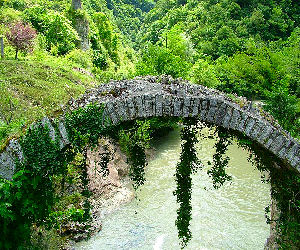
This comes after the destruction of frescos and Georgian inscriptions in churches. Reportedly, the church inscriptions in Abkhazian villages of Likhni and Ilori have been removed. XIII century Bedia church and the grave of Bagrat III, the Ambari basilica, and the famous “Kelasuri wall” have been badly damaged. In addition, King Tamar’s bridge, the basilica in Gantiadi (II-III century), the Gentsvishi fortress (early medieval period), the Ilori Saint George church dated XI century, the Mokvi church, and the Tsebeldi fortress have been desecrated.

Russian experts estimate that the budget of illegal archeological business in Russia is tantamount to the budget of the average region. The major portion of archeological findings appear on the black market and then later in private collections. Many artifacts are taken to Europe, as Europeans know where to invest money. For this reason, Moscow has adopted a special law against “black archeology”.

Georgian culture and frescos are disappearing

Malkhaz Baramidze PhD, head of the Bronze Era Department of the Archeology Research Center and a member of Abkhazia’s Academy of Science, leads a group working on current, problematic issues in Abkhazia. Baramidze says that this topic is not new and that the materials found during archeological excavations in Abkhazia later appeared in the museums of Sochi or St.Petersburg and that many Georgian inscriptions dating from the early, middle and late medieval period have disappeared. In order to rescue Georgian monuments in Abkhazia the Georgian government asked UNESCO for help.

“We are often informed that Georgian cultural monuments are damaged on the territory of Abkhazia. However we are not eligible to check this information. In this regard we demanded to implement monitoring of Georgian cultural monuments in Abkhazia in partnership with UNESCO representatives. In 1996 the program was launched. We demanded to involve Murtaz Uridia, one of the best specialists in this group. He used to be engaged in rehabilitation of Bedia church. Though unfortunately the monitoring of Georgian monuments on the territory of Abkhazia was not carried out, as Abhazians did not allow the group to the territory due to the lack of security guarantees,” states Baramidze.

Georgian cultural monuments in Abkhazia are being badly damaged during the “rehabilitation” activities. Reportedly, the firm of uncertain origin “Baroque” is rehabilitating the churches of New Athens and Pitsunda.

The Georgian Patriarchy has repeatedly expressed its resentment that the rehabilitation process may cause serious damage to ancient frescos, icons and churches themselves. According to Paata Davitaia, former Minister of Justice of Abkhazia’s legitimate government and leader of the political party “We Ourselves”, many samples of Georgian art were kept in the Sokhumi museum. Icons were there, along with wine pitchers, vases, pots, various jewelry, weapons and other items found in graves during archeological excavations. Currently there is almost nothing left in the museum.

Davitaia explained that the premier of de facto authority, Ankvab, has made statements about it. He spoke on the TV channel NTV. “Recently studio ‘profession reporter’ made a program ‘Abkhazia’s black archeology’ depicting black archeologists arriving in Abkhazia, hold archeological excavations and take away found masterpieces of art and culture. In this regard Ankvab expressed his resentment and declared that Abkhazians blocked the border and strengthened control. Besides the frescos remained at churches are taken to Russia as if for the rehabilitation works. Then they are taken to various countries from Russia” stated Davitaia.

According to Davitaia, black archeologists found samples from the antique period discovered by archeologists during decades of archeological excavations in Abkhazia after the cease-fire was removed.

“Stalin’s billiard, a valuable thing for Georgian cultural heritage kept in Ritsa villa was sold to Russian businessman at USD 50 000. It is note-worthy that the ruins of the ancient city are discovered on Sokhumi coast. At present Black Sea covers the territory. The divers in Sokhumi always studied this ruins and they found many samples of Sokhumi art and life in the sea. Now this process is uncontrolled. Some interested people arrive from abroad, pay money, hire divers and take away anything they find. The local population is also involved in this process. Black archeologists buy things found by local inhabitants- antique pots, vases, gold, weapons, crosses decorated with precious stones,” said Davitaia.

Black archeology was common even in the Soviet period. Artifacts discovered in Abkhazian territory often appeared in Sochi, Adleri or Tuabse museums.

“Yuri Voronov was one of the biggest black archeologists. Many conferences are dedicated to his memory in Abkhazia. In Tsebelda he found and took away materials of Romanian period dated A.D. I-II centuries. He carried out excavations without any permission. In 1967 the Academy of Sciences of Georgia sent a special commission to Moscow in this regard. Voronin’s response was -“What’s up? What a noise? All our archeologists sell materials.

Voronin took away the well-known ‘Primorsk treasure’ from Georgia and sold to Hermitage in St.Petersburg. When we learned about it we tried to find official documents on purchase, but they did not tell us the name of seller. They showed only part of documents listing purchased things,” states Malkhaz Baramidze.

After the suspension of military activities from 1992 to1993, Madina Ardzinba, daughter of the former separatist leader Vladislav Ardzinba, became involved in the black archeology process. Three years ago, in autumn of 2004, before the inauguration of Sergey Bagapsh, Russian agencies disseminated news that Madina Ardzinba, historian and daughter of Vladislav Ardzinba, was detained at the check-point of the Georgia-Russian border carrying antique and precious items. Aleksandr Ankvab took part in this operation, but at that time, he was one of the opposition leaders.

Finally, various Abkhazian and Russian websites provide information claiming that since 2001, joint Abkhazian-Russian archeological expeditions have been carried out in Abkhazia. Moreover, it seems that not only Russian but also Greek archeologists are interested in the excavation process. Greek specialists have expressed their willingness to participate in excavations in early 2003. The Russian Academy of Sciences assumed responsibility to finance joint activities. The matter concerned excavations not only at Abkhazian coast, but under water as well. This research was based on the photos made from cosmos.

As it seems, Russian archeologists do not waste their time and there is nothing wrong with joint archeological expeditions. Nevertheless, the Georgian state should have control over the mechanisms and illegally found as well as legally discovered materials should not be taken to Russia.