The present de facto government of Abkhazia refers to the existence of the Soviet Socialist Republic that was created in 1925.
This republic was created by the greatest dictator of all time, Stalin, and his helpers. In the 30s Nestor Lakoba (an Abkhazian communist/nationalist) organized the assimilation of the Georgian peasant population. People who agreed to register as Abkhazian were freed from military service, received cattle and other privileges. Tens of thousands of Georgians were happy to accept such an offer because in their opinion they were already Abkhazians (i.e. inhabitants of the province of Abkhazia). But the real purpose was to increase the (registered) number of Apsua (a Northern Caucasus people that moved to the (attractive) Black Sea shores.
In the 70s such assimilation programs were repeated, now with promise of cars, houses and university access.
In 1993 hundreds of thousands of Georgians were driven from Abkhazia, tens of thousands were brutally murdered and abused. Participants in these murders now hold posts in the Abkhazian government.
Most other ethnic groups have meanwhile also left Abkhazia. The result is a mono-ethnic "republic". In this so-called republic the Georgian language is officially forbidden as well as Georgian schools and education in the Georgian language. Georgian refugees are not allowed to return to their homes. In the Gali district a young child played with a Georgian flag. Because of this it was brutally hit in the face by Abkhazian police-officers.
Some Georgians dared to return to this Gali district, the part of Abkhazia closest to Georgia. They are forbidden to harvest any fruit from their gardens.
This criminal government is financed by Russia, the Russian government knows this and takes part in it. They provide weapons and military instructions.
Fake tourism programs are launched to promote Abkhazia as a tourist destination.
The country is full of hidden mass-graves of Georgian inhabitants (including many women and children), their families are still looking for them.
Solution: 300.000 Georgian refugees return to their homes, democratic elections are held and a referendum to decide the future status of Abkhazia. Those who participated in war crimes and genocide have to be brought to justice.
Until this happens the Abkhazian republic is a fake.
See for more:
Ethnic cleansing of Georgians in Abkhazia
Report by Human Rights Watch Helsinki about ethnic cleansing committed in Abkhazia
Playlist: 1992-93 ETHNIC CLEANSING OF GEORGIANS IN APKHAZETI
Sunday, March 23, 2008

Saturday, March 22, 2008
Independence Illusions of Separatist Regimes
Another question is what justice there is in the claim to independence of Abkhazia and "South Ossetia" (Original name: Samachablo) in comparison with Kosovo.
Black Archaeology-- big business in Abkhazia
Instead of discovering and preserving the history of Georgia, cultural artifacts are being pillaged in the separatist region of Abkhazia.
The practice of black archeology (excavation for the purpose of robbery) began several centuries ago. However, even now, it is easy to find numerous artifacts from Abkhazia and all of Georgia on the Russian and European black markets. Just recently, Joseph Stalin’s pool table, kept in his villa in Ritsa, was sold to a Russian executive for $50,000.
Our cultural heritage is being taken away and the process is so irreversible that even Abkhazians have begun to take it serious. Aleksandr Ankvab, premier-minister of de facto authorities, made statements on this issue and confirmed that valuable museum exhibits, historical monuments and precious icons are indeed being taken away from Abkhazian territory.
Items found during archeological excavations in Abkhazia, exhibits from the Sokhumi state museum, icons and other units of cultural meaning are being sold in Russia. Some are sold illegally, others “officially”—like the medieval frescos from ancient Georgian churches—under the guise of rehabilitation and maintenance.
Abkhazia’s museum exhibits are taken to Russia on the basis of an agreement between Sokhumi and Krasnodar territory museums to rehabilitate icons and mosaic coatings. They are taken from Abkhazia for rehabilitation but then they are never returned.
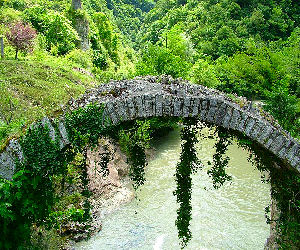
This comes after the destruction of frescos and Georgian inscriptions in churches. Reportedly, the church inscriptions in Abkhazian villages of Likhni and Ilori have been removed. XIII century Bedia church and the grave of Bagrat III, the Ambari basilica, and the famous “Kelasuri wall” have been badly damaged. In addition, King Tamar’s bridge, the basilica in Gantiadi (II-III century), the Gentsvishi fortress (early medieval period), the Ilori Saint George church dated XI century, the Mokvi church, and the Tsebeldi fortress have been desecrated.
Russian experts estimate that the budget of illegal archeological business in Russia is tantamount to the budget of the average region. The major portion of archeological findings appear on the black market and then later in private collections. Many artifacts are taken to Europe, as Europeans know where to invest money. For this reason, Moscow has adopted a special law against “black archeology”.
Georgian culture and frescos are disappearing
Malkhaz Baramidze PhD, head of the Bronze Era Department of the Archeology Research Center and a member of Abkhazia’s Academy of Science, leads a group working on current, problematic issues in Abkhazia. Baramidze says that this topic is not new and that the materials found during archeological excavations in Abkhazia later appeared in the museums of Sochi or St.Petersburg and that many Georgian inscriptions dating from the early, middle and late medieval period have disappeared. In order to rescue Georgian monuments in Abkhazia the Georgian government asked UNESCO for help.
“We are often informed that Georgian cultural monuments are damaged on the territory of Abkhazia. However we are not eligible to check this information. In this regard we demanded to implement monitoring of Georgian cultural monuments in Abkhazia in partnership with UNESCO representatives. In 1996 the program was launched. We demanded to involve Murtaz Uridia, one of the best specialists in this group. He used to be engaged in rehabilitation of Bedia church. Though unfortunately the monitoring of Georgian monuments on the territory of Abkhazia was not carried out, as Abhazians did not allow the group to the territory due to the lack of security guarantees,” states Baramidze.
Georgian cultural monuments in Abkhazia are being badly damaged during the “rehabilitation” activities. Reportedly, the firm of uncertain origin “Baroque” is rehabilitating the churches of New Athens and Pitsunda.
The Georgian Patriarchy has repeatedly expressed its resentment that the rehabilitation process may cause serious damage to ancient frescos, icons and churches themselves. According to Paata Davitaia, former Minister of Justice of Abkhazia’s legitimate government and leader of the political party “We Ourselves”, many samples of Georgian art were kept in the Sokhumi museum. Icons were there, along with wine pitchers, vases, pots, various jewelry, weapons and other items found in graves during archeological excavations. Currently there is almost nothing left in the museum.
Davitaia explained that the premier of de facto authority, Ankvab, has made statements about it. He spoke on the TV channel NTV. “Recently studio ‘profession reporter’ made a program ‘Abkhazia’s black archeology’ depicting black archeologists arriving in Abkhazia, hold archeological excavations and take away found masterpieces of art and culture. In this regard Ankvab expressed his resentment and declared that Abkhazians blocked the border and strengthened control. Besides the frescos remained at churches are taken to Russia as if for the rehabilitation works. Then they are taken to various countries from Russia” stated Davitaia.
According to Davitaia, black archeologists found samples from the antique period discovered by archeologists during decades of archeological excavations in Abkhazia after the cease-fire was removed.
“Stalin’s billiard, a valuable thing for Georgian cultural heritage kept in Ritsa villa was sold to Russian businessman at USD 50 000. It is note-worthy that the ruins of the ancient city are discovered on Sokhumi coast. At present Black Sea covers the territory. The divers in Sokhumi always studied this ruins and they found many samples of Sokhumi art and life in the sea. Now this process is uncontrolled. Some interested people arrive from abroad, pay money, hire divers and take away anything they find. The local population is also involved in this process. Black archeologists buy things found by local inhabitants- antique pots, vases, gold, weapons, crosses decorated with precious stones,” said Davitaia.
Black archeology was common even in the Soviet period. Artifacts discovered in Abkhazian territory often appeared in Sochi, Adleri or Tuabse museums.
“Yuri Voronov was one of the biggest black archeologists. Many conferences are dedicated to his memory in Abkhazia. In Tsebelda he found and took away materials of Romanian period dated A.D. I-II centuries. He carried out excavations without any permission. In 1967 the Academy of Sciences of Georgia sent a special commission to Moscow in this regard. Voronin’s response was -“What’s up? What a noise? All our archeologists sell materials.
Voronin took away the well-known ‘Primorsk treasure’ from Georgia and sold to Hermitage in St.Petersburg. When we learned about it we tried to find official documents on purchase, but they did not tell us the name of seller. They showed only part of documents listing purchased things,” states Malkhaz Baramidze.
After the suspension of military activities from 1992 to1993, Madina Ardzinba, daughter of the former separatist leader Vladislav Ardzinba, became involved in the black archeology process. Three years ago, in autumn of 2004, before the inauguration of Sergey Bagapsh, Russian agencies disseminated news that Madina Ardzinba, historian and daughter of Vladislav Ardzinba, was detained at the check-point of the Georgia-Russian border carrying antique and precious items. Aleksandr Ankvab took part in this operation, but at that time, he was one of the opposition leaders.
Finally, various Abkhazian and Russian websites provide information claiming that since 2001, joint Abkhazian-Russian archeological expeditions have been carried out in Abkhazia. Moreover, it seems that not only Russian but also Greek archeologists are interested in the excavation process. Greek specialists have expressed their willingness to participate in excavations in early 2003. The Russian Academy of Sciences assumed responsibility to finance joint activities. The matter concerned excavations not only at Abkhazian coast, but under water as well. This research was based on the photos made from cosmos.
As it seems, Russian archeologists do not waste their time and there is nothing wrong with joint archeological expeditions. Nevertheless, the Georgian state should have control over the mechanisms and illegally found as well as legally discovered materials should not be taken to Russia.
The practice of black archeology (excavation for the purpose of robbery) began several centuries ago. However, even now, it is easy to find numerous artifacts from Abkhazia and all of Georgia on the Russian and European black markets. Just recently, Joseph Stalin’s pool table, kept in his villa in Ritsa, was sold to a Russian executive for $50,000.
Our cultural heritage is being taken away and the process is so irreversible that even Abkhazians have begun to take it serious. Aleksandr Ankvab, premier-minister of de facto authorities, made statements on this issue and confirmed that valuable museum exhibits, historical monuments and precious icons are indeed being taken away from Abkhazian territory.
Items found during archeological excavations in Abkhazia, exhibits from the Sokhumi state museum, icons and other units of cultural meaning are being sold in Russia. Some are sold illegally, others “officially”—like the medieval frescos from ancient Georgian churches—under the guise of rehabilitation and maintenance.
Abkhazia’s museum exhibits are taken to Russia on the basis of an agreement between Sokhumi and Krasnodar territory museums to rehabilitate icons and mosaic coatings. They are taken from Abkhazia for rehabilitation but then they are never returned.
This comes after the destruction of frescos and Georgian inscriptions in churches. Reportedly, the church inscriptions in Abkhazian villages of Likhni and Ilori have been removed. XIII century Bedia church and the grave of Bagrat III, the Ambari basilica, and the famous “Kelasuri wall” have been badly damaged. In addition, King Tamar’s bridge, the basilica in Gantiadi (II-III century), the Gentsvishi fortress (early medieval period), the Ilori Saint George church dated XI century, the Mokvi church, and the Tsebeldi fortress have been desecrated.
Russian experts estimate that the budget of illegal archeological business in Russia is tantamount to the budget of the average region. The major portion of archeological findings appear on the black market and then later in private collections. Many artifacts are taken to Europe, as Europeans know where to invest money. For this reason, Moscow has adopted a special law against “black archeology”.
Georgian culture and frescos are disappearing
Malkhaz Baramidze PhD, head of the Bronze Era Department of the Archeology Research Center and a member of Abkhazia’s Academy of Science, leads a group working on current, problematic issues in Abkhazia. Baramidze says that this topic is not new and that the materials found during archeological excavations in Abkhazia later appeared in the museums of Sochi or St.Petersburg and that many Georgian inscriptions dating from the early, middle and late medieval period have disappeared. In order to rescue Georgian monuments in Abkhazia the Georgian government asked UNESCO for help.
“We are often informed that Georgian cultural monuments are damaged on the territory of Abkhazia. However we are not eligible to check this information. In this regard we demanded to implement monitoring of Georgian cultural monuments in Abkhazia in partnership with UNESCO representatives. In 1996 the program was launched. We demanded to involve Murtaz Uridia, one of the best specialists in this group. He used to be engaged in rehabilitation of Bedia church. Though unfortunately the monitoring of Georgian monuments on the territory of Abkhazia was not carried out, as Abhazians did not allow the group to the territory due to the lack of security guarantees,” states Baramidze.
Georgian cultural monuments in Abkhazia are being badly damaged during the “rehabilitation” activities. Reportedly, the firm of uncertain origin “Baroque” is rehabilitating the churches of New Athens and Pitsunda.
The Georgian Patriarchy has repeatedly expressed its resentment that the rehabilitation process may cause serious damage to ancient frescos, icons and churches themselves. According to Paata Davitaia, former Minister of Justice of Abkhazia’s legitimate government and leader of the political party “We Ourselves”, many samples of Georgian art were kept in the Sokhumi museum. Icons were there, along with wine pitchers, vases, pots, various jewelry, weapons and other items found in graves during archeological excavations. Currently there is almost nothing left in the museum.
Davitaia explained that the premier of de facto authority, Ankvab, has made statements about it. He spoke on the TV channel NTV. “Recently studio ‘profession reporter’ made a program ‘Abkhazia’s black archeology’ depicting black archeologists arriving in Abkhazia, hold archeological excavations and take away found masterpieces of art and culture. In this regard Ankvab expressed his resentment and declared that Abkhazians blocked the border and strengthened control. Besides the frescos remained at churches are taken to Russia as if for the rehabilitation works. Then they are taken to various countries from Russia” stated Davitaia.
According to Davitaia, black archeologists found samples from the antique period discovered by archeologists during decades of archeological excavations in Abkhazia after the cease-fire was removed.
“Stalin’s billiard, a valuable thing for Georgian cultural heritage kept in Ritsa villa was sold to Russian businessman at USD 50 000. It is note-worthy that the ruins of the ancient city are discovered on Sokhumi coast. At present Black Sea covers the territory. The divers in Sokhumi always studied this ruins and they found many samples of Sokhumi art and life in the sea. Now this process is uncontrolled. Some interested people arrive from abroad, pay money, hire divers and take away anything they find. The local population is also involved in this process. Black archeologists buy things found by local inhabitants- antique pots, vases, gold, weapons, crosses decorated with precious stones,” said Davitaia.
Black archeology was common even in the Soviet period. Artifacts discovered in Abkhazian territory often appeared in Sochi, Adleri or Tuabse museums.
“Yuri Voronov was one of the biggest black archeologists. Many conferences are dedicated to his memory in Abkhazia. In Tsebelda he found and took away materials of Romanian period dated A.D. I-II centuries. He carried out excavations without any permission. In 1967 the Academy of Sciences of Georgia sent a special commission to Moscow in this regard. Voronin’s response was -“What’s up? What a noise? All our archeologists sell materials.
Voronin took away the well-known ‘Primorsk treasure’ from Georgia and sold to Hermitage in St.Petersburg. When we learned about it we tried to find official documents on purchase, but they did not tell us the name of seller. They showed only part of documents listing purchased things,” states Malkhaz Baramidze.
After the suspension of military activities from 1992 to1993, Madina Ardzinba, daughter of the former separatist leader Vladislav Ardzinba, became involved in the black archeology process. Three years ago, in autumn of 2004, before the inauguration of Sergey Bagapsh, Russian agencies disseminated news that Madina Ardzinba, historian and daughter of Vladislav Ardzinba, was detained at the check-point of the Georgia-Russian border carrying antique and precious items. Aleksandr Ankvab took part in this operation, but at that time, he was one of the opposition leaders.
Finally, various Abkhazian and Russian websites provide information claiming that since 2001, joint Abkhazian-Russian archeological expeditions have been carried out in Abkhazia. Moreover, it seems that not only Russian but also Greek archeologists are interested in the excavation process. Greek specialists have expressed their willingness to participate in excavations in early 2003. The Russian Academy of Sciences assumed responsibility to finance joint activities. The matter concerned excavations not only at Abkhazian coast, but under water as well. This research was based on the photos made from cosmos.
As it seems, Russian archeologists do not waste their time and there is nothing wrong with joint archeological expeditions. Nevertheless, the Georgian state should have control over the mechanisms and illegally found as well as legally discovered materials should not be taken to Russia.
Monday, December 3, 2007
Upper Abkhazia
Upper Abkhazia (Georgian: ზემო აფხაზეთი, Zemo Apkhazeti; Abkhaz: Аҧсны хыхьтəи , Apsny khykh'twi) is an official Georgian name for a mountainous district in northeastern Abkhazia, a breakaway republic, which is internationally recognized as an autonomous republic within Georgia. It is currently the only part of Abkhazia controlled by the central Georgian authorities and the de jure government of the Autonomous Republic of Abkhazia. The village of Chkhalta is an administrative center of Upper Abkhazia.
Geographically, Upper Abkhazia comprises the upper Kodori Valley, the Chkhalta Ridge, and the Marukhi Pass on the border with the Russian Federation. Populated by some 2,000 people, chiefly ethnic Georgians (Svans), the area occupies approximately 17 percent of Abkhazia’s territory and is of high strategic importance due to its proximity to the Abkhaz-held capital of Sukhumi, and other important cities in the region.
The term Upper Abkhazia has been largely used by the Georgian officials and media since the successful July 2006 operation of Georgian forces in the Kodori Valley which established firmer Georgian presence in the region. Prior to that, the Georgian government had exercised a very loose control over Kodori even though the Abkhaz separatist forces had never been able to penetrate the valley, and the area had largely been run, since 1994, by the local warlord Emzar Kvitsiani who was dislodged in the abovementioned Georgian police operation.
On September 27, 2006, on the 13th anniversary of the fall of Sukhumi to the Abkhaz rebels and their allies from the Northern Caucasus (1993) the Kodori region and the adjacent pieces of land governed by Georgia were officially renamed into Upper Abkhazia and declared as a "temporary administrative center" of Abkhazia and the headquarters of the de jure Abkhazian government. [4]In spite of Abkhaz and Russian protests, a new office of the de jure government was inaugurated, on the same day, by a high ranking delegation from Georgia's capital Tbilisi, including President Mikheil Saakashvili and the Catholicos Patriarch Ilia II.
The area is currently undergoing a major rehabilitation program, including the reconstruction of infrastructure and reinforcement of security services. The Central Election Commission of Georgia has recently established the constituency in Upper Abkhazia, allowing the population of the area, for the first time in the recent history of Georgia, take part in the Georgian local elections, 2006.
Geographically, Upper Abkhazia comprises the upper Kodori Valley, the Chkhalta Ridge, and the Marukhi Pass on the border with the Russian Federation. Populated by some 2,000 people, chiefly ethnic Georgians (Svans), the area occupies approximately 17 percent of Abkhazia’s territory and is of high strategic importance due to its proximity to the Abkhaz-held capital of Sukhumi, and other important cities in the region.
The term Upper Abkhazia has been largely used by the Georgian officials and media since the successful July 2006 operation of Georgian forces in the Kodori Valley which established firmer Georgian presence in the region. Prior to that, the Georgian government had exercised a very loose control over Kodori even though the Abkhaz separatist forces had never been able to penetrate the valley, and the area had largely been run, since 1994, by the local warlord Emzar Kvitsiani who was dislodged in the abovementioned Georgian police operation.
On September 27, 2006, on the 13th anniversary of the fall of Sukhumi to the Abkhaz rebels and their allies from the Northern Caucasus (1993) the Kodori region and the adjacent pieces of land governed by Georgia were officially renamed into Upper Abkhazia and declared as a "temporary administrative center" of Abkhazia and the headquarters of the de jure Abkhazian government. [4]In spite of Abkhaz and Russian protests, a new office of the de jure government was inaugurated, on the same day, by a high ranking delegation from Georgia's capital Tbilisi, including President Mikheil Saakashvili and the Catholicos Patriarch Ilia II.
The area is currently undergoing a major rehabilitation program, including the reconstruction of infrastructure and reinforcement of security services. The Central Election Commission of Georgia has recently established the constituency in Upper Abkhazia, allowing the population of the area, for the first time in the recent history of Georgia, take part in the Georgian local elections, 2006.
Sunday, December 2, 2007
Ethnic cleansing of Georgians in Abkhazia

Left: Georgian survivors of the war are studying photographs of corpses, hoping to discover (the fate of) a loved-one.In spring 1992, especially in June-July, acts of armed aggression and attacks got systematic character on highways and railways of Georgia. These attacks caused serious economic damages to the country. Criminal bands robbed trains and seized Georgian and other countries’ goods. Georgian government had no choice but to defend the highways and railways by the national army in order to secure safe travel of goods. As Autonomous Republic of Abkhazeti was the main area of the criminal bands action, on August 1992 Georgian central leadership decided to bring additional troops into Abkhazeti. This decision had been preliminarily submitted to the region leaders’ approval. It was personally coordinated with Chairman of Supreme Council Vladislav Ardzinba. The movement of the Georgian Army within the Georgian territory became a reason for starting the conflict. Here is what was written on this subject by Chervonaya Svetlana – Ph.D., leading specialist of Institute of Technology and Anthropology of Academy of Sciences of Russia (see the bibliography):
"Shevardnadze did not start this war. By noon of the 14th of August 1992, «the Georgian party» had not fired a shot, none Georgian soldier had been brought into Sokhumi yet, and nothing was threatening the peace in Abkhazian towns and villages. Vladislav Ardzinba declared this war on Georgia in his radio speech. He drew the Abkhazian people into the heinous crime. Vladislav Ardzinba announced total, forced «general mobilization» (every man from 18 to 45). He provided the soldiers with arms seized or stolen from Russian arsenal, and promoted unlawful actions of the Abkhazian armed troops in Abkhazian towns, villages, and roads (the "enemy" had not even reached this territory). The Abkhazian separatists searched for everything they considered worthy, terrorized and killed Georgian peaceful inhabitants. Abkhazian snipers opened fire to people being in Sokhumi sanatorium. They shot scores of Russian holidaymakers on the beach of the air defense forces’ and other sanatoriums. These were the crimes that had to be stopped. The criminals must answer for these deeds. The political purposes of the organizers of these crimes are known: division of Georgia, drawing Russia into a war, Soviet-communist revenge and restoring the Soviet Union."
That is how the war broke out.
"...When they [Abkhaz] entered Gagra, I saw Shamyl Basaev's battalion. I have never seen such a horror. They were raping and killing everyone who was captured and dragged from their homes. The Abkhaz commander Arshba raped a 14 year old girl and later gave an order to execute her. For the whole day I only could hear the screams and cries of the people who were brutally tortured. On the next day, I witnessed the mass execution of people on the stadium. They installed machine guns and mortars on the top and placed people right on the field. It took a couple of hours to kill everybody..."
Georgian government repeatedly appealed to the UN, CSCE, and other international organizations to intervene, while at the same time refusing offers of Russian military assistance. Several UN Security Council resolutions and decisions failed to lead to a de-escalation of the conflict. On July 27, 1993, a Russian-brokered trilateral agreement on a cease-fire and principles for the solution of the Georgian-Abkhazian conflict was signed. Complete demilitarization of the region, supervised by Russia, was to follow the separation of the military forces of the two sides. However, the UN failed to implement its long-sought decision to send a large group of military observers to Abkhazeti. Furthermore, the Russian military observers insisted that Georgians did not participate in the supervision of the withdrawal of heavy weaponry.
"...When the Abkhaz entered my house, they took me and my seven year old son outside. After forcing us to kneel, they took my son and shot him right in front of me. After they grabbed me by hair and took me to the nearby well. An Abkhaz soldier forced me to look down that well; there I saw three younger men and couple of elderly women who were standing soaked in water. They were screaming and crying while the Abkhaz were dumping dead corpses on them. Afterwards, they threw a grenade there and placed more people inside. I was forced again to kneel in front of the dead corpses. One of the soldiers took his knife and took the eye out from one of the dead near me. Then he started to rub my lips and face with that decapitated eye. I could not take it any longer and fainted. They left me there in a pile of corpses..."
At the end of August 1993, S. Shoigu, chairman of the Russian Emergency State Committee, declared on Russian television that demilitarization had reached a stage at which resumption of the war would be impossible. Large numbers of hopeful refugees returned to their ruined homes and began rebuilding. Then on September 17, a surprise attack by Abkhazian tanks and artillery, supported by their Russian North Caucasian and Cossack allies, forced the remaining disarmed Georgian troops, together with tens of thousands of civilians, to flee in panic. Many of these victims later starved or froze to death in the Svaneti mountains. Shevardnadze himself, who was besieged along with the defenders of Sokhumi, had a narrow escape. The sudden clandestine Abkhazian rearmament remains a mystery only for the extremely naive.
"...The Abkhaz separatists killed people of other nationalities as well, including those who tried to protect Georgians. After the city was seized, the streets were covered with bodies. Separatists destroyed the Baramidze, Chkhetia, Baramia, Gvazava, Dzidziguri, Absandze, Shonia, and Kutsia families, as well as many others..."
The war ended in late September 1993 with Abkhazeti’s virtual secession from Georgia through a radical ethnic cleansing of its multi-ethnic population and the destruction of its cities, including Sokhumi.Just at the beginning of the war adherents of Vladislav Ardzinba started killing, tormenting, raping, and robbing the inhabitants of Georgian nationality. At first Georgians of the following towns and villages experienced the sadism of the separatists: Gagra and Gudauta, Akhaladze, Bzipi, Ipnari, Otkhara, Akhali Sopeli, Eshera, Kochara, Ketevani, Labra, Kvitouli, Kindgi, etc. Ugrekhelidze, an inhabitant of the village Eshera, was forced to dig a hole of his own height, then he was pulled out his teeth and nails, and buried alive. They left his hand above the ground (the symbol of the Abkhazian banner.) Another Georgian was captured, cut his veins. Then the Abkhazian separatists poured his blood into glasses and drank it. After this they let him go to Sokhumi to tell everybody how Abkhazians drank Georgian blood. The Abkhazian butchers captured sisters – Eka Jvania (17 years old) and Marina Jvania (14 years old), Leila Samushia and others in village Pshadi. They undressed them in front of their parents and neighbors, and raped them. After this the Abkhazian butchers executed all of them by shooting. The Abkhazian "liberators" did not spare workers of education system. They execute by shooting 78 teachers and lecturers. For instance, a teacher Bichiko Ekimiani, Armenian, was executed by shooting together with his family in his own house; a teacher of a secondary school at village Kochaki, Bajiko Vekua firstly raped, then tormented and killed; Bichiko Baramia – an assistant professor of Abkhazian University, diseased and disabled man was executed by shooting together with his wife; Shota Jgabadze – professor was executed by shooting when he was operating a wounded patient. It’s just a drop in the ocean of separatists violence. 30000 innocent people were killed in Abkhazian War in 1992-1993.
"...They captured a young girl. She was hiding in the bushes near the house where they killed her parents. She was raped several times. One of the soldiers killed her and mutilated her. She was cut in half. Near her body they left a message: as this corpse will never be as one piece, Abkhazia and Georgia will never be united either..."
The war was over in September 1993, by actual separation of Abkhazeti From Georgia, by genocide of Georgian population, by destroying towns. As a result of the war 200000 people were forced to leave their own places of residence. The refugees moved to various regions of Georgia.In spite of Russian repeated recognition of Georgian territorial integrity, since the beginning of militant actions representatives of Russian Federation officials, several ministries, and departments, various political parties and organizations have been supported the separatists with political, military, economical, financial and moral aid. Even before the conflict, on March 1992, Autonomous Republic of Abkhazeti without submission of Georgian government approval began making economic agreements with Russian Federation. In early March V. Ardzinba applied to B. Eltsin for economical aid. On March 19, 1992 B.Eltsin ordered Krasnodar and Stavropol Administration leaders to make direct trade-economic agreements with Abkhazeti. The orders were fulfilled during the next three months.
Saturday, January 27, 2007
Facts of Genocide and Ethnic Cleansing of Georgians in Gali Region
Facts of Genocide and Ethnic Cleansing of Georgians in Gali Region
by the Abkhazian Separatists
From 20 - 26 of May 1998 and Later
Analytical group on Abkhazian issues of
the Parliament of Georgia
Georgians' Genocide still is in progress in Abkhazia
After 1993 tragedy in Abkhazia, Georgia, despite the efforts of Georgians, World Community and mediator-countries towards the peaceful settlement of the conflict, the genocide and ethnic cleansing of Georgians is in progress.
After the seizure of military operations, regular and extremely cruel genocide takes place in Gali region, where military confrontation never took place and the ethnic composition of population is homogenous- Georgian.
In the beginning of 1994 Abkhazian separatist government with carried out the cleansing of the remained and spontaneously returned IDPs in Gali. In February 8-13 Abkhazian "boeviks" and merceneries murdered more than 800 peaceful inhabitants, mostly women, children and the elders, they burnt down about 4200 houses and destroyed the economic capability of the region. Tens of thousands of people again became refugees.
In spite of the fact that peacekeeping forces under the auspices of the CIS, whose obligation was to secure return of refugees, entered Gali ragion, separatist government again carried out the cleansing of Gali population in summer and autumn of 1995-1996, the victims of these actions were more than 400 peaceful inhabitants, hundreds of residences were burnt and thousands of people again fled out from their dwellings.
Genocide and ethnic cleansing were conducted with different intensity during 1997.
Along with this, in the last two years, by means of Georgian Authority's peaceful politics and also peacekeeping forces, international military observers, UNHCR and OSCE's efforts, took place some kind of stabilization of situation, the result of it was the unorganized return of 40 000 Georgians to the security zone and creation of elementary living conditions for the population.
Separatist government, which is above all, afraid of the actual perspective of the conflict's settlement, returning of Georgian Population and restoration of the former demographic situation, from the beginning of the early spring 1998 began to implement the mean plan of Georgians' genocide and ethnic cleansing in Gali. For this purpose, the separatist government infringed the stabilization in the rayon, especially in its lower zone, in March, April and May, under pretext of fighting with so called guerrillas, they brought "boeviks", who took population as hostages, in order to receive ransom, committed different forms of violence and murders. Till May 20, 1998, "Boeviks" killed 13 peaceful inhabitants, took "hostages" about 250 people.
Separatist government with the silent consent and support of Russian peacekeeping forces, since May 20 brought into Gali rayon more than 1200 Abkhazian, Armenian, Cossaks and North Caucasian "boeviks" with a heavy armament and carried out large-scale punitive military operation against peaceful population.
In May 20-26 and the following period despite of sease-fire, taking away the troops and achieving agreement in Gagra on the returning of refugees, which was precisely fulfilled by Georgian side, separatist government killed with torture and burnt 56 people, 43 are missing, 100 were taken hostages, 2100 houses and 14 villages are completely ruined and burnt, 40 000 inhabitants became refugees again, the property of the population has been taken away. The houses, schools and health care objects, restored by UNHC (this cost 2 mln. dollars), were completely destroyed.
During the armed confrontation 21 participants of the contradiction movement and members of Abkhazian Autonomous Republic's interior forces' limited troops were killed.
In the end of May in Gali rayon were distributed the leaflets- "Death to all Georgians, Abkhazia without Georgians," and this was actually achieved.
At present no one doubts that if not the unorganized defense of the population and the appropriate measures taken by Georgian limited troops of interior forces, - the number of victims among peaceful population would have been much more.
On the other side of Enguri - in Zugdidi and Tsalenjikha regions, the situation of the expelled Georgians is extremely grave: homeless, starving, diseased, jobless, hopeless - it is impossible to describe their suffering. People live in schools, kinder-gardens, administrative buildings and farms, in many places there are 20-25 people in one room. Despite the efforts of Georgian authority and international organizations, their situation is catastrophic.
At the end of 20th century, when human rights and freedoms are recognized as supreme legal and moral categories, in Abkhazia, Gali, no one is responsible for these actions.
Unfortunately, during the tragic days of Gali, the UN observers and representatives of human rights protection international organizations, who received the part of murders' observers, took no actions. Refugees are doubtful about the capability of these institutions to fix objectively the facts of genocide and react on them.
It's a fact that during the last five years there was no real progress in the settlement of the conflict, were not fulfilled any requirements of the international documents about the political settlement of the conflict, the violence towards Georgian population goes on in front of UN military observers, at the moment in Gali rayon Georgians are killed every day, only because they are Georgians.
Abkhazian separatism is obsessed with impunity syndrome and still goes on with abusing civilized world's efforts, violating human rights and freedoms, taking away the most precious thing - the life.
The punitive operations in Gali witnesses that situation in occupied Abkhazia is under the control of Russian policy.
Long time has passed after the seizure of military operations but despite the expectations and enormous spiritual and phisical sufferings, there was still hope for the future in the refugees. Genocide and ethnic cleansing that took place in May 20-26, made obvious for everybody that the returning of the lost territory is a very distant or unrealistic dream.
We present the facts of Georgians' genocide carried out by Abkhazian separatists in May 1998 and afterwards, these are materials in which you can see the terrible facts of ethnic cleansing and bloodshed in Gali.
THE PRE-TRAGEDY PERIOD
On the 11 April from Gali rayon, village Saberio, Abkhaz "boeviks" kidnapped Gamgebeli (head of local administration) of the village Davit Eteria together with his son. Kidneppers asked for ransom.
On the 12 April in Gali rayon's village Saberio took place the clash between Abkhaz police and local inhabitants, in which interfered Russian peacekeepers. One Abkhazian died and several Russian soldiers were wounded.
Abkhazian "boeviks" in Gali rayon's village Gudava killed brothers Barkaia and captured their sister.
The group of 150 fighters was brought to Gali rayon. The group mainly consisted Abkhazian and Armenian "boeviks," inhabitants of Gudauta and Gagra. They actively participated in 1992-93 Georgians' genocide.
On 27 April in Gali rayon local inhabitants were invaded by Abkhazian "boeviks". Regarding this fact was proofed that on that day 50 men group in Abkhazian police uniforms along with Russian peacekeeping forces' tanks entered village Sida. So called police took hostages several residents. Brothers Ekhvaia are wounded. The invaders placed the hostages in the building of village Sida administration and burnt several houses. The leader of the group, distinguished by extreme cruelty, was the nephew of Givi Eshba, Civil Proceedings Division's Head of so called Gali rayon.
On 28 April in village Mziuri of Gali rayon happened the spontaneous fight. From the side of Abkhazian "boeviks" were killed two fighters, some were wounded.
On 29 April in village Shesheleti of Gali rayon happened the fight between Abkhazian "boeviks" and local population. Some people were wounded, "boeviks" took as hostages 11 people.
On 10 May in village Mziuri of Gali rayon in order to carry out punitive operations Abkhazian separatists brought so called Bagramian Battalion. The Battalion attacked peaceful population, burnt the houses and took hostages.
On 18 May three buses with Abkhazian "boeviks" entered Gali
On 20May two "Gaz 66" vehicles full of Abkhazian "boeviks" entered village Sida of Gali rayon. Took place unorganized resistance of the population. To avoid more danger the population was warned to leave their houses and take away children from the conflict zone.
Anti-Georgian meetings are organized in Ochamchire, Gudauta and Sukhumi.
The facts of genoc in Gali rayon from May 20, 1998.
In the morning of May 20, with the purpose of punitive operations first 50 men were brought to Gali rayon. Than 70 men (May 16-17), afterwards 120 men (May 18) groups of Abkhazian "boeviks", and on the 20th of May - 120 "boeviks" entered the rayon. Later, 800 men groups with means of transport on which are so called "Shilka" and heavy guns, with the support and participation of Russian Peacekeeping Forces, began punitive operations in villages Sida, Repo-Etseri and Khumushkuri, where they opened the fire to peaceful population. The population of these villages, along with local guerrillas, in order to stop the punishing operations and avoid victims was forced to resist, which resulted in an open armed fighting.
On 21 May, heavily armed 100 men group of Abkhazia "boeviks" entered Gali rayon village Khumushkuri. Georgian guerrillas managed to stop Abkhazians but additional Abkhazian forces encircled guerrillas. Abkhazians used heavy artillery and grenade-launchers.
On 22 May, Abkhazian "boeviks" took hostages 4 local inhabitants, occupied 45 houses and a mill in village Sida of Gali rayon. From village Khumushkuri were taken hostages 10 peaceful inhabitants. 100 men Abkhazian group entered territory of Mziur-Makhunjia. Two men were taken hostages. Abkhazians occupied the territory of village Pirveli Gali and completely drove the population out of the village. In community Tskhiri Abkhazians shot Zaur Tsimitia and his two children, took as hostages 4 peaceful inhabitants: Omister Nakopia, Otar Nakopia, Arvelodi Bakarandze and the guest of the family from Gulripshi, where these four are, is unknown.
On the 23-rd of May, on Saturday, Abkhazian Separatists brought to Gali additional several hundreds of policemen to carry out punishing operations against Georgian population.
On the 24-th of May, at 10 o'clock in the morning Abkhazian separatists carried out the armed attack on Gali rayon villages Khumushkuri and Kvemo Barghebi, they opened the fire to peaceful population, burnt the houses, killed the helpless old people, women and children. Local population, along with guerrillas actively resisted. This is one more evidence of Separatists' decision to complete the ethnic cleansing of Georgian population.
On the 24th of May Abkhazian "boeviks" invaded the office of the mission of UN military observers in Gali, disarmed and beat the members of the guard and surrounded the building.
On 24 May, 1998 in order to secure safe escape of the civilian population from the conflict zone, armed unites of the Internal Ministry were introduced into certain villages of Gali region.
On 25 May, 1998 Abkhaz "boeviks" murdered correspondent of the newspaper "Resonance" Giorgi Chania in the Gali region village of Ganakhleba.
25-26 May, Abkhaz "boeviks", applying massive military force, committed large-scale punitive operations against in the following villages of the Gali region: Tagiloni, Nabakevi, Ganachleba, Gagida, Otobaia. They robbed local population of livestock, burnt down their dwellings and infrastructure and mercilessly looted the local population.
Shootings are still going on. 26-27 May, armed clashes took place in village Dikhazurga. At the same night, the Abkhaz separatists burnt more than 25 houses in villages Dikhazurga and Saberio. The next day hostilities resumed. According to the trustworthy source of information, there were 545 households in Dikhazurga. Because of violence, 80% of these households were burnt down. The Abkhaz separatists were supported by the Russia "peace keepers" in carrying out their punitive operations.
Despite of the agreement on cease fire by 6a.m. 0f 26 May reached between the parties to the conflict, by 9a.m. situation became very explosive in the Saberio direction, where Enguri hydroelectric station's control panel is situated. Abkhazians carried out punitive operations here and as a result peaceful civilians were forced to abandon their dwellings and found refuge in Zugdidi. The abkaz "boeviks" took hostages, murdered and burnt alive helpless civilians.
There are about 30 thousand IDPs from the Gali region in Zugdidi and Tsalendjikha regions. Mostly, they live in schools and other administrative buildings. As a rule, 15-20 persons live in one room. Despite the fact that different towns and regions of Georgia did their best to render humanitarian aid to refugees, it proved extremely difficult to provide IDPs with the essentials and food products. International humanitarian organizations are rendering humanitarian assistance as well.
The International Red Cross has not played any positive role in the course of the events. The IDPs asked the aforementioned organization to render assistance in the evacuation of the wounded, the elders, children and women from the conflict zone. In response, representatives of the Red Cross Zugdidi office demanded full guarantee of their safety.
On 28 May, the Abkhaz separatists staged another violent raid in Zugdidi region villages situated beyond the river Enguri. At that time separatists aimed at the village Khurcha and took two Georgian young men as hostages. The destiny of these men is unknown to the Georgian side.
According to the uncompleted date, during these days 17 partisans and 56 civilians were killed. It is believed that common grave of 100 civilians is in the surroundings of Gali. The Georgians were not allowed make a video shot of these corpses. According to the eyewitnesses, there were facts of brutal torture and burning alive of helpless civilians.
Situation is still tense in the Gali region. The Abkhazian militia and "boeviks" debauching. Due to the passiveness of Russian peace keeping forces,
UN military observers and other missions, murder, robbery, burning of dwellings is frequent. Almost all goods are taken from the houses and aftermath these houses are burnt, cattle are slaughtered. There is complete chaos impunity. Abkhazians are mining bridges, roads and paths.
On 2 July, at 7a.m Abkhaz "boeviks" burnt several houses in Tagiloni and Nabakevi. In the village of Tagiloni Abkhazians took invalid Amiran Okudjava as hostage and looted villagers who happened to return to take their personal belongings.
On 2 June, the separatists enforced their checkpoints on the river Enguri. Passage of civilians between the Zugdidi and Gali regions is banned. The so called Internal Ministry forces of Abkhazia seek to control the whole coast line in order to prevent passage of population from Zugdidi to Gali.
Georgian population leaves their houses because of Abkhazians new attack. Abkhazians occupied villages Zemo and Kvemo Barghebi. Abkhazian "boeviks" actively carried out military operations using mine-shooters; they burn houses, administrative buildings, kill the rest of old people, take hostages.
Subscribe to:
Posts (Atom)